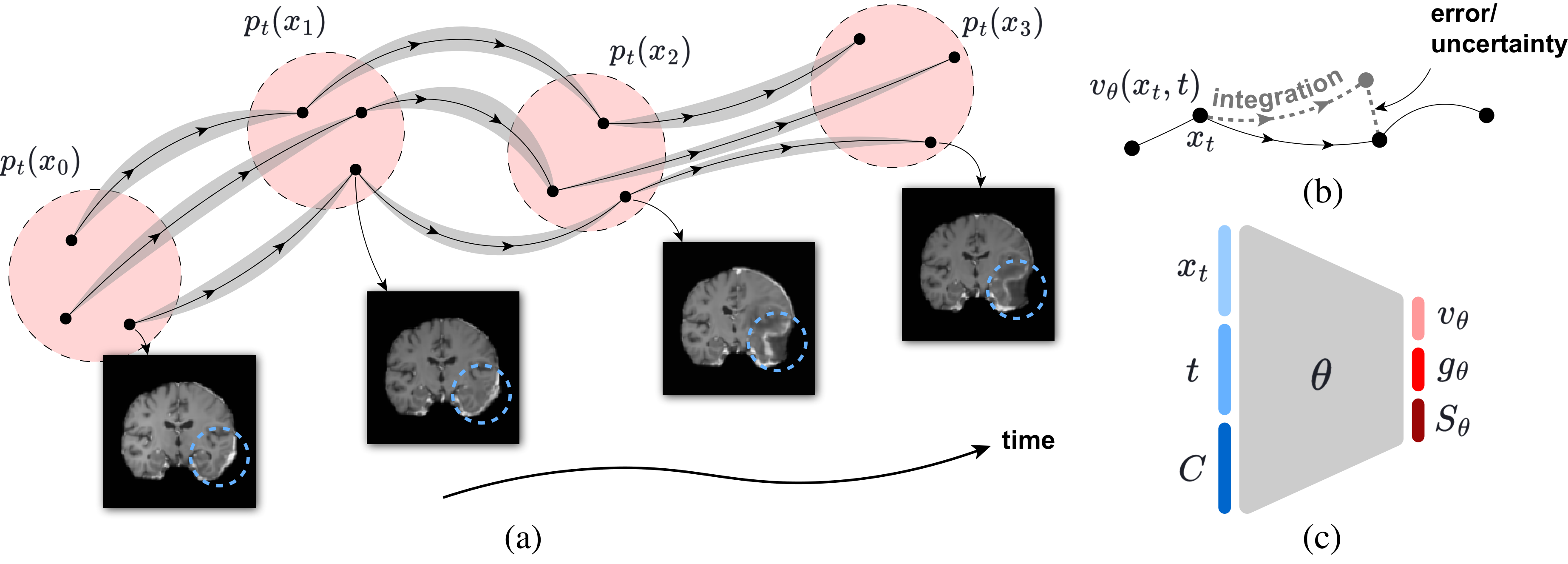
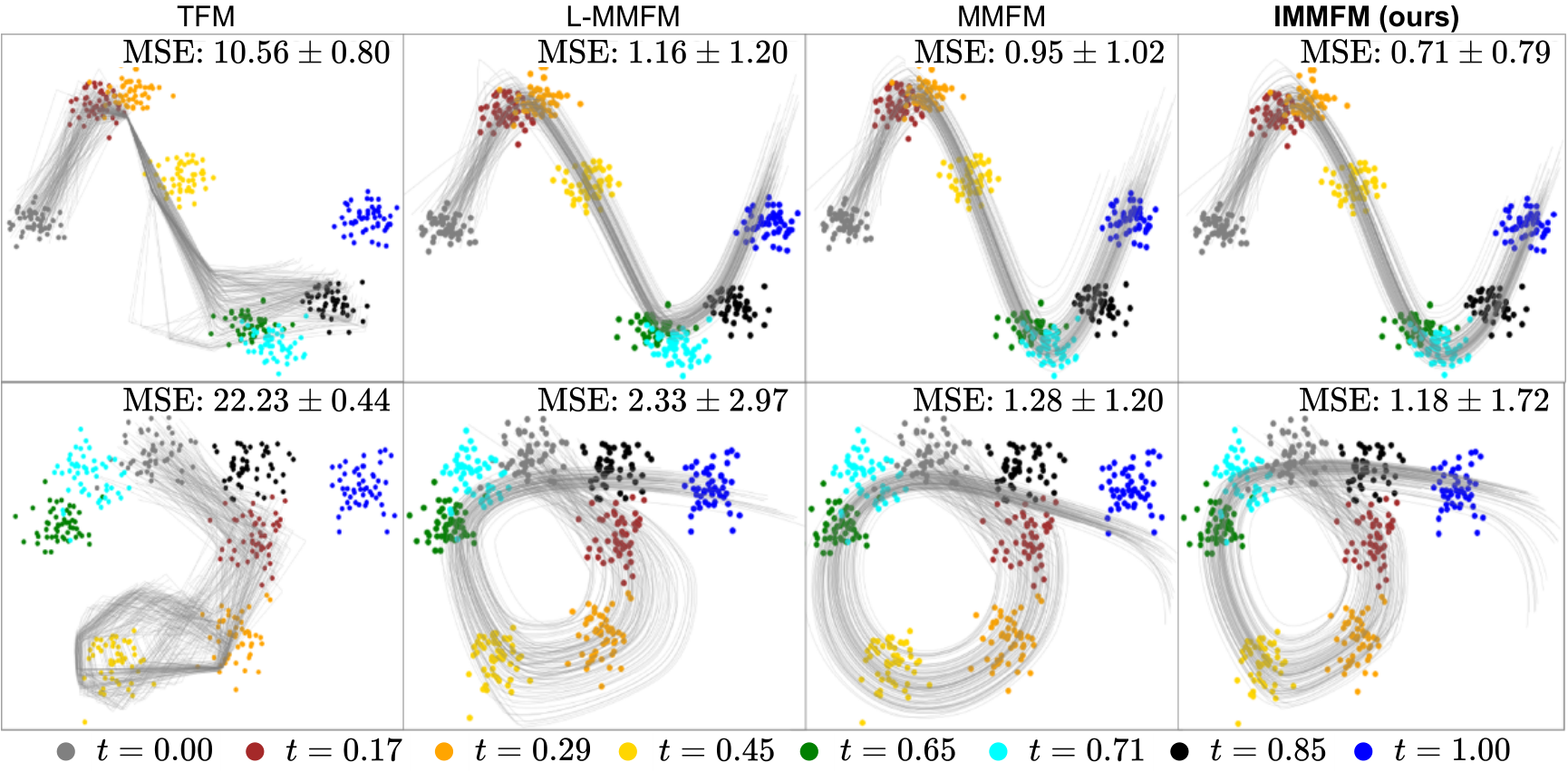
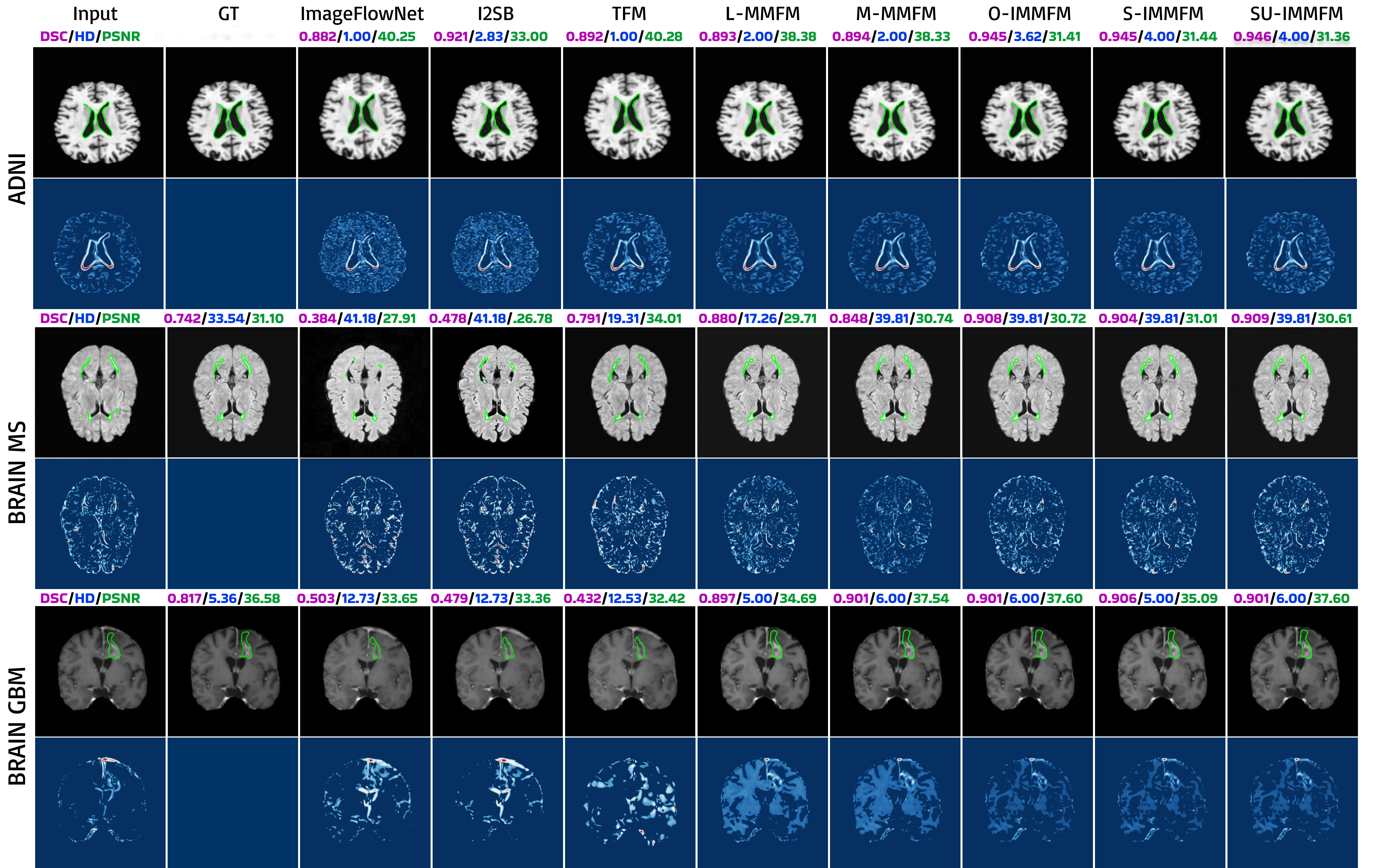
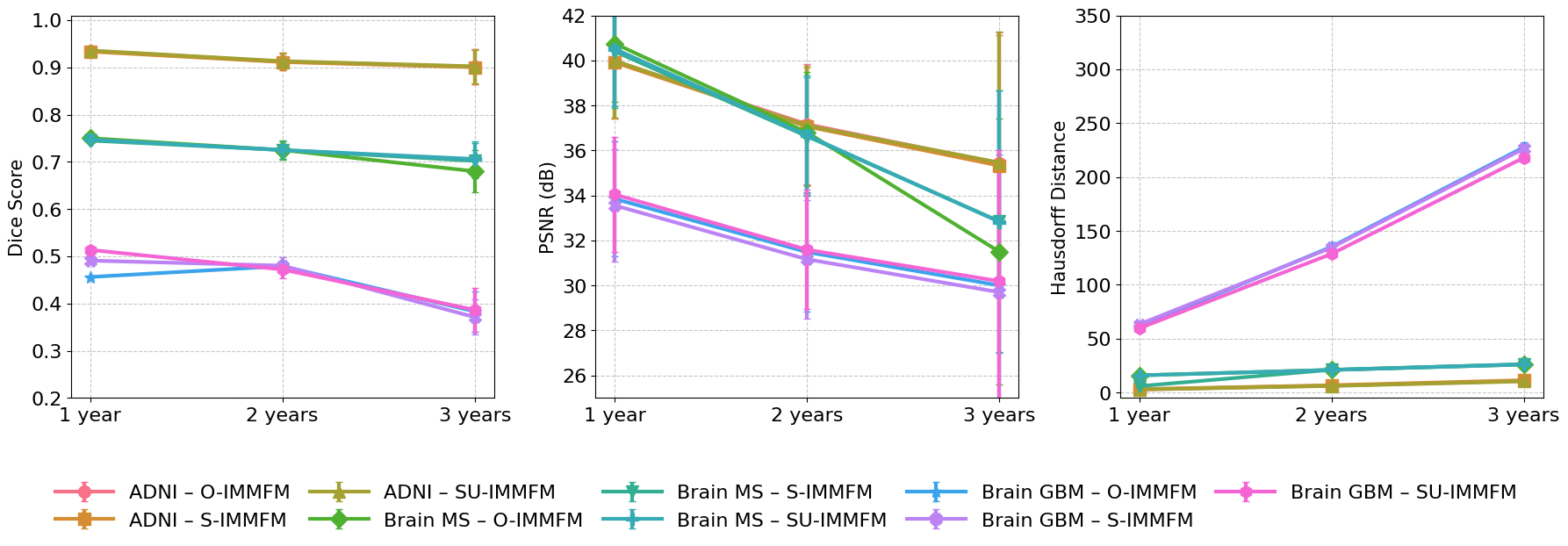
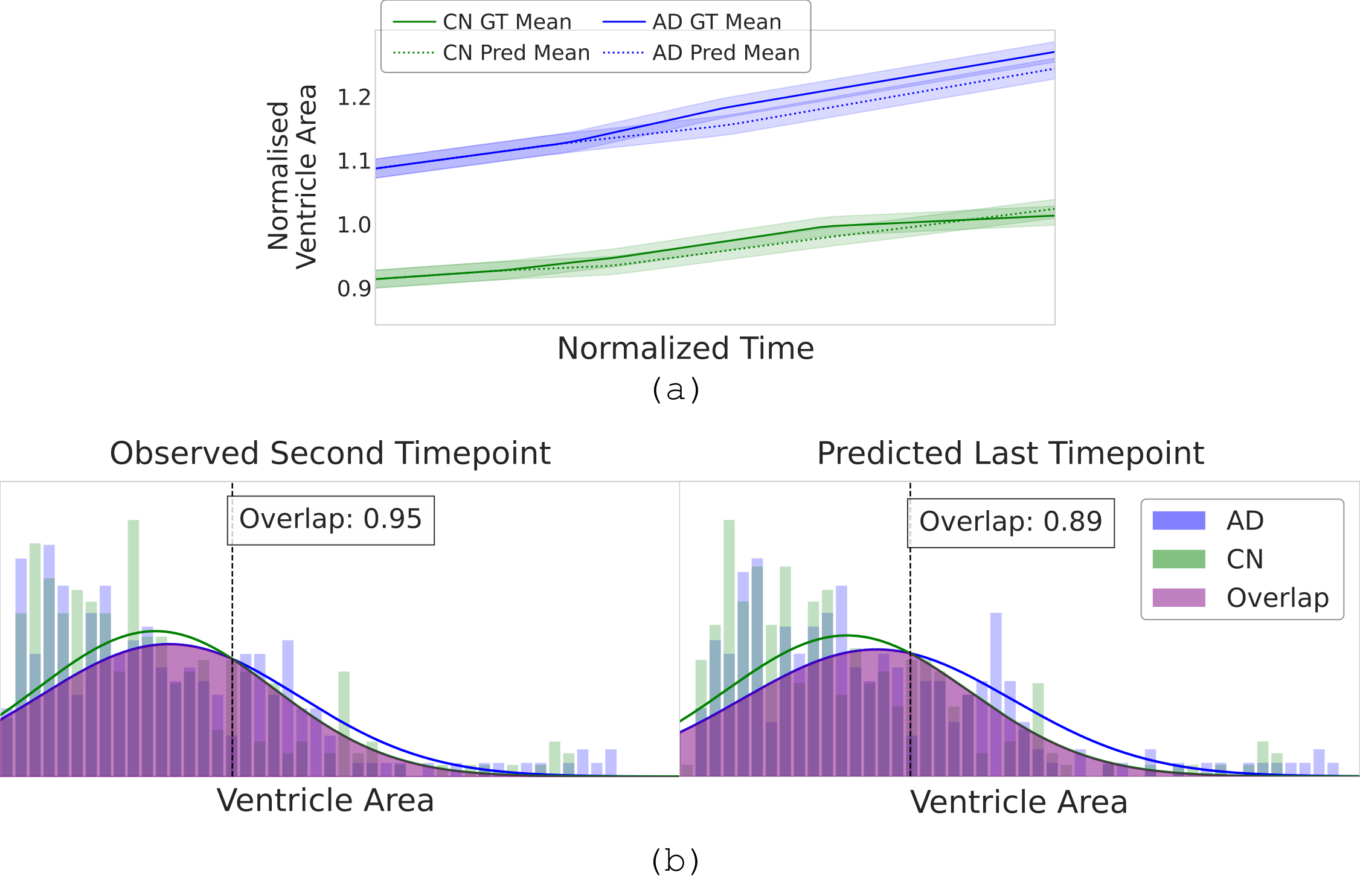
Our generative framework models trajectories as an Itô stochastic differential equation (SDE), simultaneously learning a transport flow and stochastic deviations to generate medically realistic progression.
1. MMOT as Spatial Diffeomorphic Registration
We uniquely formulate the Multi-Marginal optimal transport (MMOT) problem not as a naive pixel-matching task, but as a sequential spatial alignment and diffeomorphic registration problem. By finding smooth, invertible transformations that directly map one timepoint's image onto the next, we guarantee a topologically sound pathway prior for the continuous flow model right at the dataset foundation.
2. Piecewise-Quadratic Conditional Path
Unlike simple linear multi-marginal interpolation that creates discontinuous velocity fields, we construct a quadratic velocity formulation that smoothly blends velocities between consecutive trajectory segments. The mean path incorporates both current segment velocity and anticipated velocity from the next segment, with time-dependent blending that creates smooth transitions. This approach exhibits a beneficial low-pass filtering effect that ensures Lipschitz continuity required for stable flow matching training, effectively regularizing against ill-posed vector fields in sparse data regimes.
3. Learned Uncertainty as Trajectory Correction
Rather than predicting classical variances or calibration confidence intervals, IMMFM learns a high-dimensional directional corrective diffusion coefficient. This term operates in latent space and serves as part of the prediction mechanism rather than a separate uncertainty estimate. Jointly optimized with the drift via our theoretical equilibrium condition, it is explicitly regressed to the squared prediction error and dynamically guides the SDE trajectory toward better reconstruction.
Theoretical Guarantee: We prove that learning this uncertainty term does not bias the drift learning—the stationary points remain identical to the drift-only case. This allows stable joint optimization where the uncertainty adaptively corrects for local prediction errors while preserving the underlying trajectory dynamics.
Depending on the computational budget and physiological stochasticity, the framework acts as a versatile suite. For smoother, deterministic motions (like limb kinematics in the Starmen dataset), our ODE variant (O-IMMFM) naturally excels by focusing computational resources on drift learning. Conversely, for highly volatile progressions like tumor growth (GBM dataset), the full Stochastic SU-IMMFM formulation is deployed where the learned diffusion component effectively captures chaotic volatility that the smooth quadratic drift cannot model.